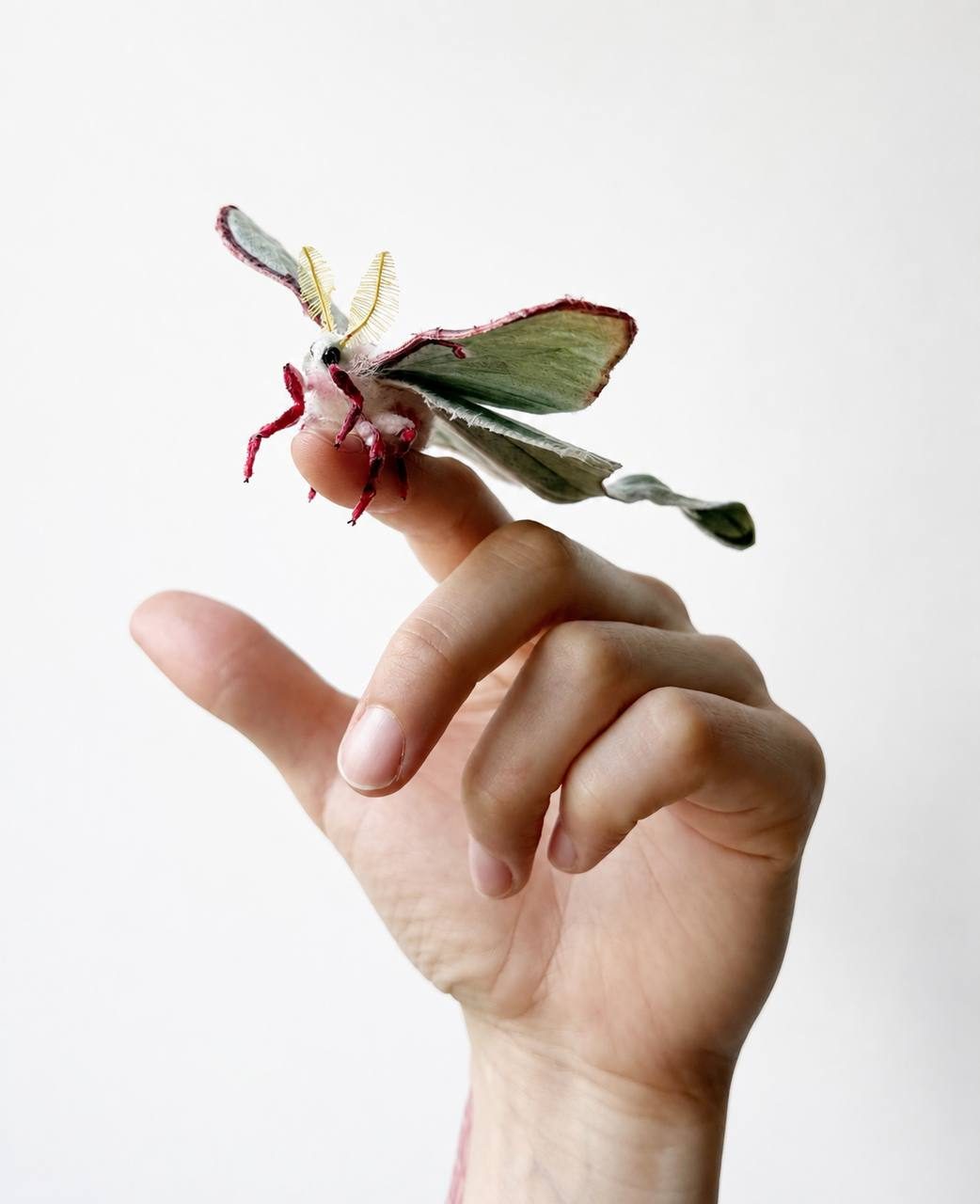
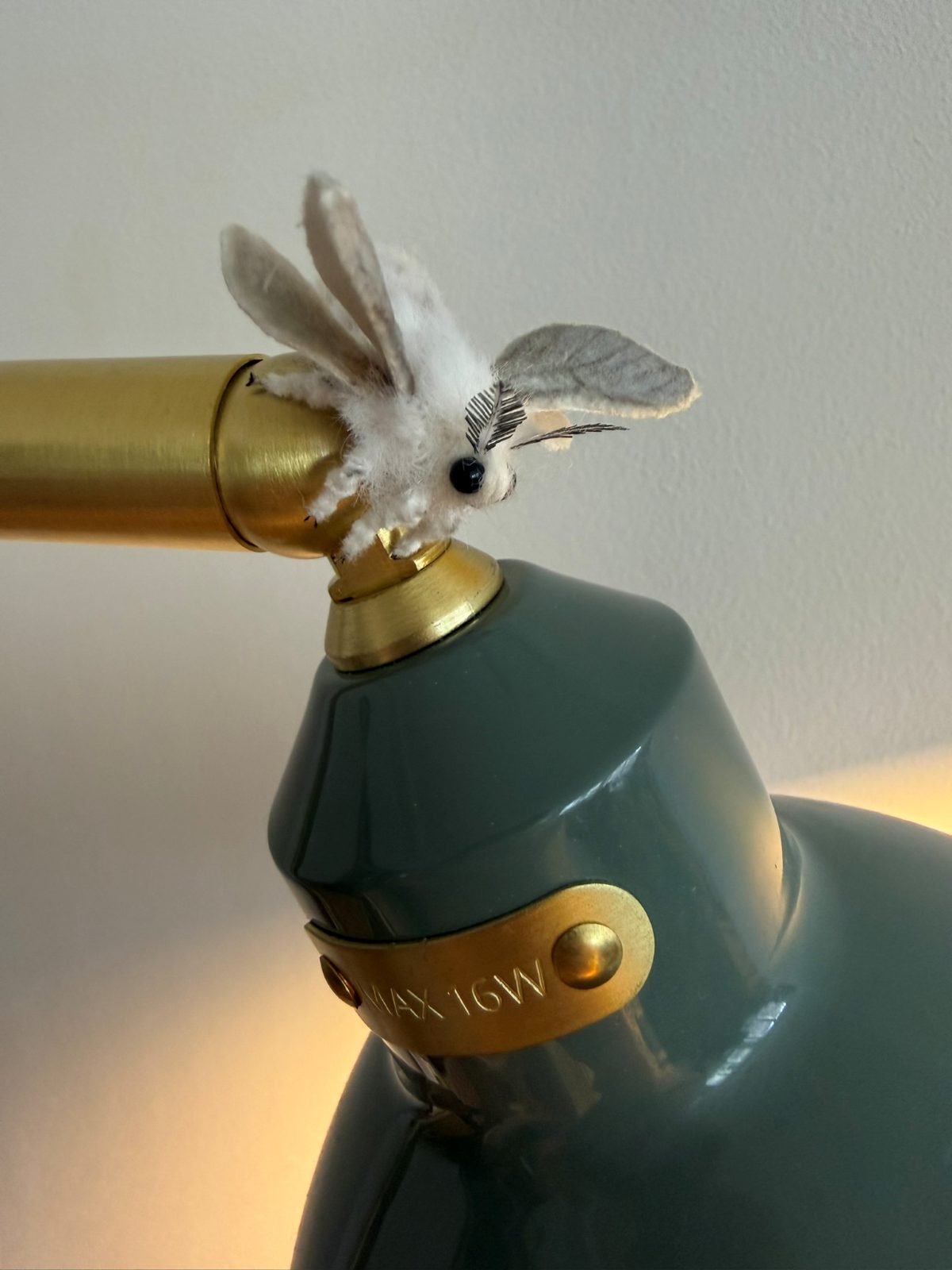
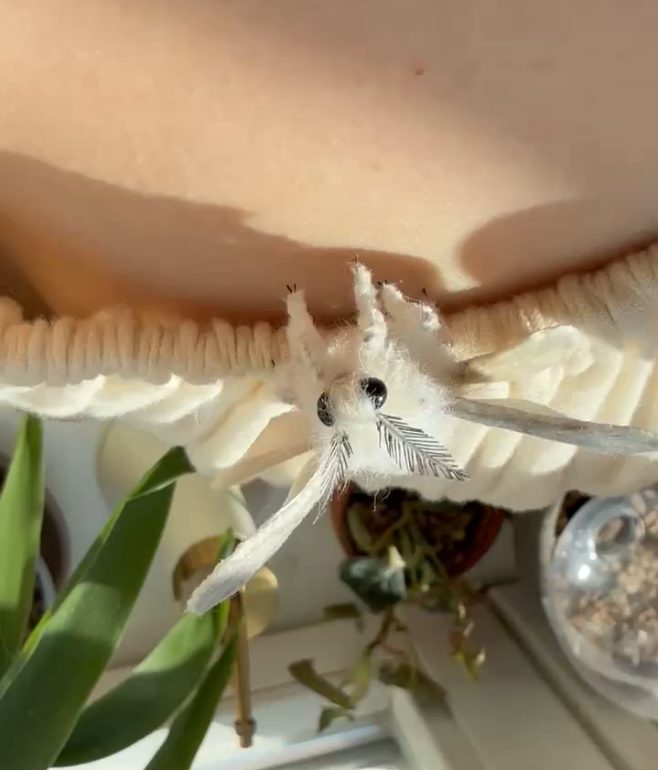
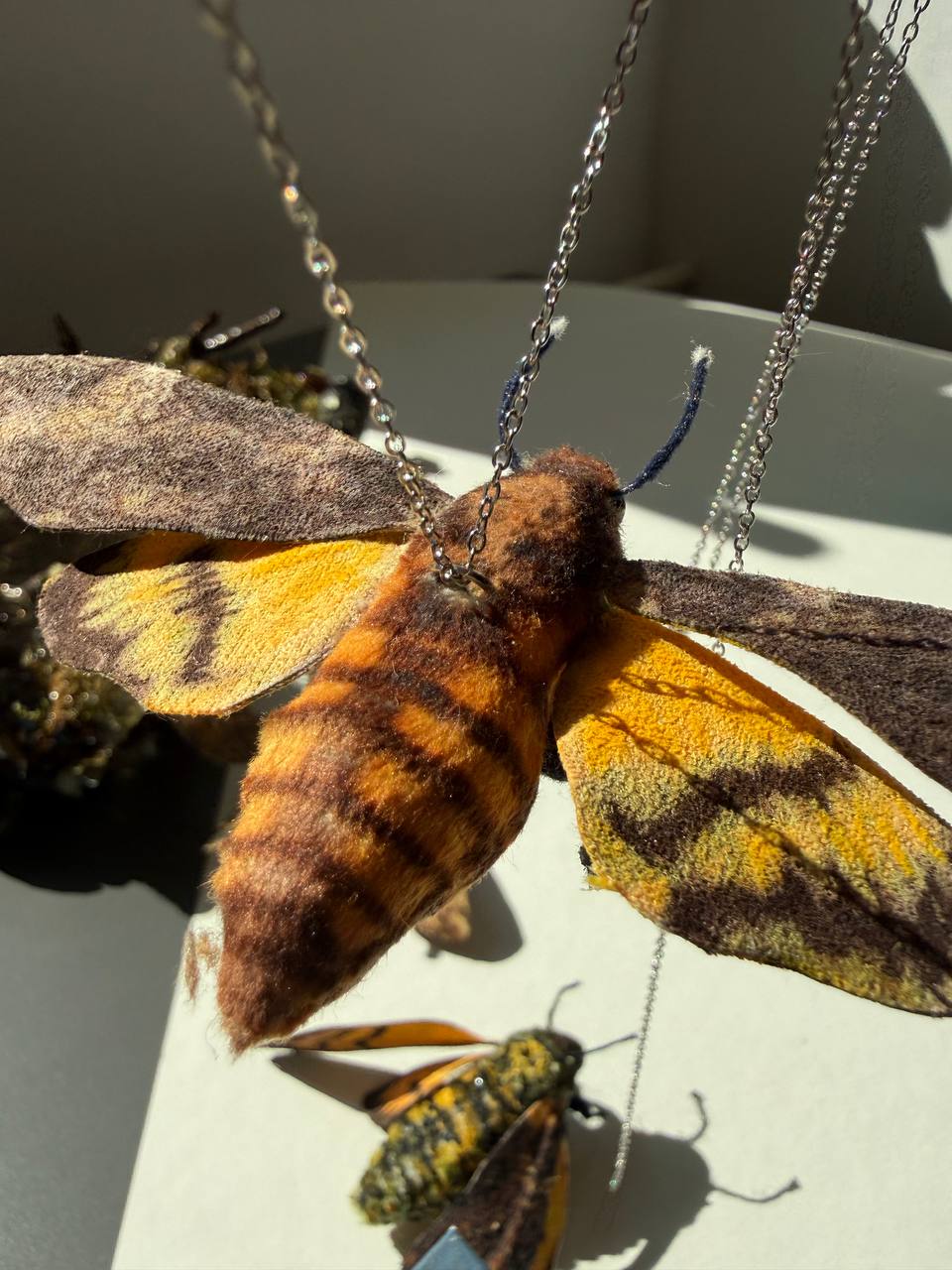
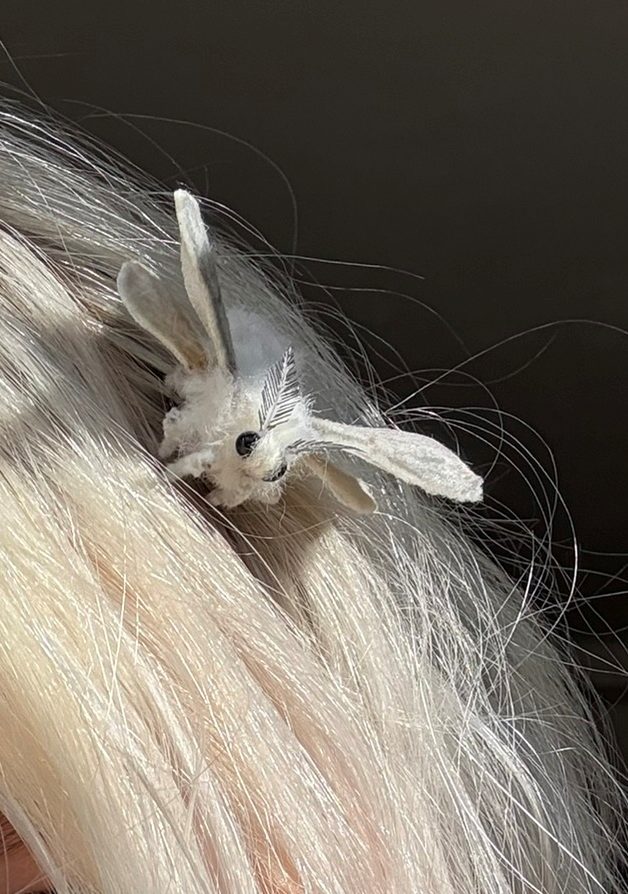
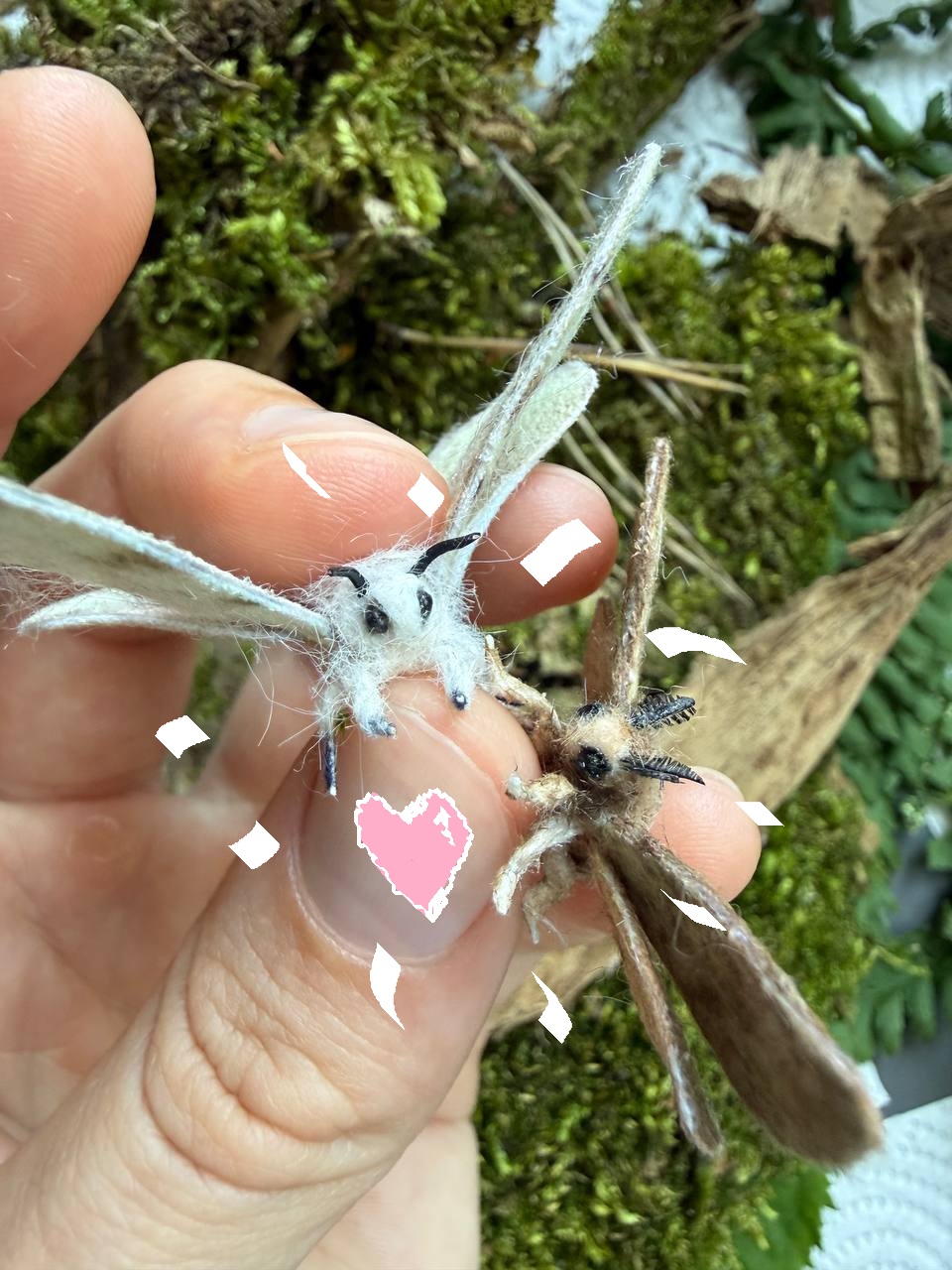
I love moths. Their furry bodies, shiny curious eyes, soft dusty wings. But they live so briefly, and you can't touch a pinned specimen, can't carry it with you, can't feel its fur. So I developed a technique to recreate every part of a moth from fibre: wings, legs, antennae, body, exactly as it should be anatomically.
Studio status · SeptemberThe shop has just been restocked — everything available is waiting below. I'm working through commissions now, so I'm not planning another update for about a month.
I'm Lina. I studied entomology for five years, sewed and embroidered for most of my life, and one day combined the two. Each moth needs its own technique, and I try to capture every one's character in as much detail as I can — the soft, fluffy ones and the stranger, more unusual moths alike.
Available now
Each one is a single, one-of-a-kind moth ready to live with you.
Previously made
Moths that have already found their homes. Every one of them can be made again — each will come out a little different.
Commission a moth
Any species I've made can be made again, in the size you'd like. Pick one below, or tell me about something else entirely.
€30 deposit secures your commission
Lead time up to 8 weeks from payment
Balance due before dispatch
Each moth is unique — yours will come out a little different
Due to high demand, please make sure you're ready for the wait
Size, colours and mounting we'll agree by email after the deposit. Anything you want me to know can go in the note at checkout.
Free add-on
Permanent mounting options
Each moth comes with a magnet system. If you'd like to wear yours as jewellery (earring, pendant, brooch), I can build in a permanent mount, free of charge.
I work in mixed technique — partly traditional, partly methods I worked out myself while testing new materials and learning what they can do. Every moth turns out unique.
Shipping to you takes 3–4 business days by tracked courier.
A note for me
Anything you'd like me to know — a wish for your commission, a colour, a date you need it by, or just hello.
450 characters left
Place your order
You will be redirected to Stripe to complete your payment securely. All payment details are collected on the secure checkout page.
About
Hi! I'm Lina.
Entomologist & maker. Obsessively detailed.
I adore moths. Not just their wings, but their fuzzy bodies, tiny black eyes, ridiculous feathery antennae, soft little legs. I think they are the most beautiful creatures alive.
They don't live very long, though. And dried specimens you can't touch, can't carry with you. I wanted moths that look like they might fly away, that you can actually hold. So I started making them from fibre.
I spent five years in an entomology lab in Siberia, studying bees and moths. Before that it was a childhood of sewing, embroidery, toys, clay. I always made things with my hands. When I left the lab and moved to Europe, I combined the two: the scientific eye and the textile hands.
There are other insect sculptors out there, and some of them are incredible. Most work in resin, wire, or paper. I came from textiles. I love fibre for its softness, for the way it catches light like real fur. Working with it is slow. I shape each moth fibre by fibre, with no template, just a reference photo and a lot of patience. A single moth takes about a week — and another week before it, for the sketching and the sample-making, so two in all.
Every species needs a different technique. The anatomy, the scale, even the dyes are different each time. I spend a lot of time experimenting — testing materials, trying things that don't work, finding the one that does. You can't mechanise this work and you can't delegate it, because there is no algorithm to follow. What I can promise you is that every moth I send out has everything I know how to do in it, and a good deal of my heart besides.
Techniques
Needle feltingRonghua embroideryClay sculptingFibre dyeingHand embroideryMixed media
Based in
Czech Republic
Background
Entomology, 5 years laboratory research
Commissions
Open · up to 8 weeks
Tutorials
In development
If you've read this far, thank you. I mean it. This is my whole life packed into a small website, and the fact that you're here matters to me.
I try to make my moths as realistic as possible, so the default attachment is invisible: a small neodymium magnet inside the body, paired with a matching magnet you place on the other side of fabric, a surface, or inside a display case.
What comes included
Moths with a magnet inside ship with a matching magnet mounted on an alligator clip. Clip it to clothing, a bag, a curtain, a lampshade, your hair — the moth holds on from the other side, and lifts off just as easily. If you'd prefer the counterpart magnet on something other than a clip, tell me and I'll make it that way.
Every moth travels in a protective cardboard carrying case, so it arrives safely and you can take it with you wherever you go.
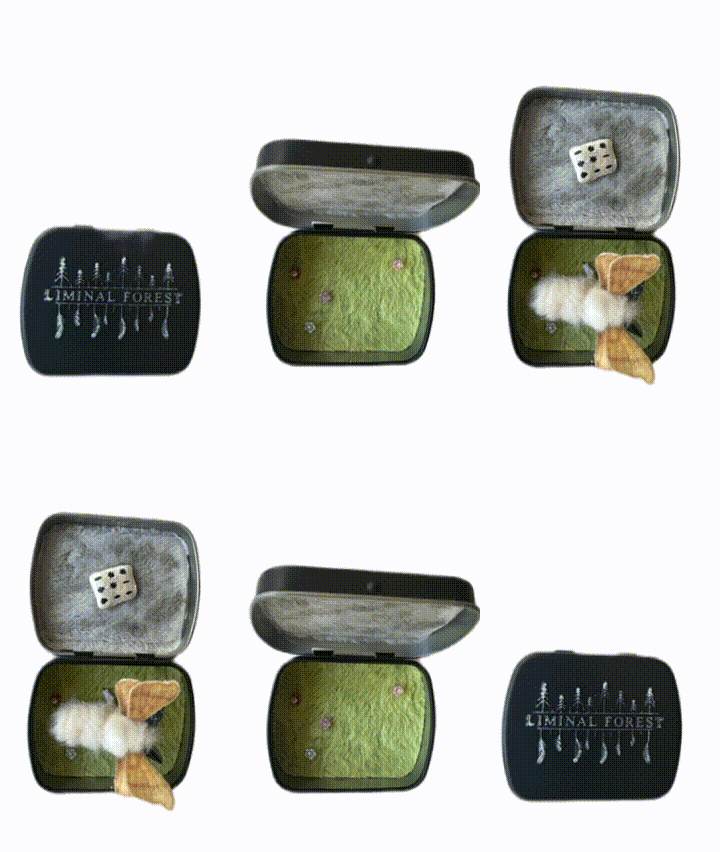
I can also pack your moth into a matte black metal tin case with a soft world tucked inside: a hand-embroidered meadow of hand-dyed mohair, glass beads and freshwater pearls, beneath a hand-dyed cloudy sky. These are made to order, either with an existing design or embroidered to your wishes — write to me and we'll arrange it.
Permanent mounts, free of charge
If you'd like to wear your moth more securely, or use it as jewellery, I can build in a permanent, non-removable mounting before shipping. Just let me know when ordering. This is free, it's part of making the moth yours.
Pin (stud)
Stud earring, lapel pin, hat pin. A small metal post with a butterfly clutch back. The most discreet one.
Cuff
Ear cuff, clothing edge, bag strap. A spring clip that grips fabric or cartilage. No piercing needed.
Back loop
Pendant, necklace, hair clip (legs up). A small ring on the back. The moth hangs naturally, wings spread.
Belly loop
Pendant, necklace, hair clip (wings up). A ring under the abdomen. The moth hangs upside down, wings pointing up.
Not sure which mount suits your moth? Message me, I'm happy to help.
Each moth is a handmade fibre sculpture. It's delicate and detailed, but it will last a long time if you treat it gently. Here's how to keep it looking good.
Water & washing
Water itself is safe — your moth won't be harmed by damp air or a little rain. What it can't take is washing: please don't put it in a machine, soak it, or scrub it.
Do keep detergents, solvents and cosmetics away from it. Those can change the colours, and that is the one thing I can't undo.
The very fluffy moths are the exception — I'd rather you didn't wet them at all. If one does get damp, let it dry and comb the fur back into place with a soft toothbrush, brushing from head to tail. It fluffs up again beautifully.
Wings & legs
The wings and legs are flexible and fairly sturdy, but they are not meant for repeated forceful bending. Please do not aggressively bend and re-bend them.
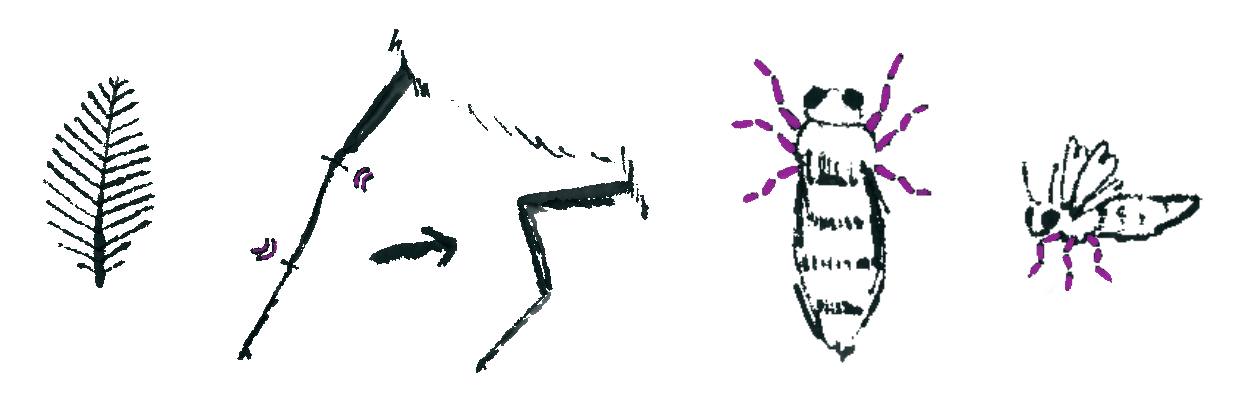
Most of my moths have joints built into their legs, so the legs bend where a real moth's would. Some species are made differently — more freely movable, without joints.
So if you feel you've bent a leg into an odd position, nothing is broken. Just put it back: straighten the leg carefully, then bend it again following the diagram below. Two bends per leg, spaced roughly along its length, and the shape looks natural again.
Antennae
The antennae are the most delicate part — please don't squeeze or crease them.
They are coated with a protective layer, though, which stays more or less flexible depending on the species. That coating makes them waterproof, so damp weather is no threat to them.
Storage & general handling
Handle gently and avoid pressure, crushing, or friction during storage or wear.
A normal room is all it needs — no special conditions. Just keep it from being rubbed or pressed for long stretches, and out of reach of curious pets.
Important safety note
This item is not a children's toy and not a toy for pets. It is a collectible art piece, made for display or for very careful wear. Please handle it as a delicate handmade object.
Anything else?
If you have any other questions about looking after your moth, or something has gone wrong with it, please just write to me. I'm always reachable and happy to help — it's my moth too, in a way.
Your payment was successful. A confirmation email with your receipt has been sent to your email address.
What happens next
1
In-stock items will be carefully packaged and shipped via express courier. Expected delivery: 3 to 4 business days.
2
Commission orders: your deposit secures your place in the queue. Production takes up to 8 weeks. I'll send you photos of the finished piece before shipping so you can see it first. The remaining balance is due before dispatch.
Questions about your order? Just reply to your receipt email or write to liminal.forest.crafts@gmail.com, I'll get back to you personally.
Last updated: April 2026 · Effective from: 13 April 2026
1. Seller / Provozovatel
This online shop at liminalforest.com is operated by:
Elina Sokolova
Vysočanská 237/101, 190 00 Praha 9, Česká republika
IČO: 23250275 · Neplátce DPH (not VAT-registered)
Registered as a self-employed person (OSVČ) in the Czech Trade Register
E-mail: liminal.forest.crafts@gmail.com
Hereinafter referred to as "the Seller". The customer placing the order is hereinafter referred to as "the Buyer".
2. Scope & governing law
These Terms & Conditions ("Terms") govern the contractual relationship between the Seller and the Buyer arising from the purchase of goods through the website liminalforest.com. The legal relationship is governed by the laws of the Czech Republic, in particular Act No. 89/2012 Coll., the Civil Code (občanský zákoník), and, where the Buyer is a consumer, by Act No. 634/1992 Coll., on Consumer Protection. For consumers resident elsewhere in the EU, mandatory consumer protection rules of the Buyer's country of habitual residence continue to apply where they offer greater protection.
3. Products & nature of the goods
All items offered are original handmade artworks — fibre sculptures, botanical jewellery and mixed-media art objects — produced by the Seller in her Prague studio. Because each piece is made by hand, slight variations in colour, texture, proportion and materials are an inherent characteristic of the work and are not considered defects. Product photographs reflect the item as accurately as possible; minor deviations due to screen calibration, lighting or the organic nature of materials (moss, lichen, wool, natural fibres) may occur.
The goods are decorative art objects and are not intended as toys, children's items, or objects of daily use.
4. Prices & payment
All prices displayed on the website are final and shown in EUR, USD or CZK at the Buyer's choice via the currency switcher. The Seller is not a VAT payer (neplátce DPH) and prices therefore do not contain VAT. Shipping is calculated separately at checkout based on the destination zone.
Payment is processed securely by Stripe Payments Europe, Ltd. The Seller does not store card data on its own servers. Accepted payment methods include all major debit and credit cards supported by Stripe, and selected local methods where available.
For commission and pre-order items, a non-refundable deposit of EUR 30 (or equivalent in the chosen currency) is payable at the time of order. The remaining balance is invoiced and must be paid before dispatch.
5. Conclusion of contract
The product listing on the website constitutes an invitation to treat. The purchase contract is concluded at the moment the Seller confirms the Buyer's order by e-mail (automatic order confirmation from Stripe after successful payment is considered such confirmation). An electronic tax receipt/invoice is issued automatically via Stripe and sent to the e-mail address provided at checkout.
6. Delivery
Items in stock are dispatched from Prague within 3–7 working days of payment. Delivery within the Czech Republic and EU is handled by express courier and typically takes 2–4 working days. Worldwide delivery times vary depending on the destination and customs clearance. The Seller is not responsible for delays caused by the courier, postal authorities, or customs inspections beyond her control. Risk of damage to the goods passes to the Buyer upon handover by the courier.
7. Commission & made-to-order items
Commission pieces are made to order according to the Buyer's individual requirements. Production lead time is typically 4–8 weeks from the date of payment of the deposit, depending on workload and material availability. The Seller will send approval photographs before dispatch. Because commissioned pieces qualify as "goods adjusted to the Buyer's wishes or personal needs" within the meaning of § 1837 letter d) of the Czech Civil Code, the statutory 14-day right of withdrawal described in Section 8 below does not apply to them. The deposit is non-refundable.
8. Right of withdrawal (for consumers)
A Buyer who is a consumer is entitled to withdraw from the contract without giving any reason within 14 days of the date on which the goods are received, in accordance with § 1829 (1) of the Czech Civil Code. Notice of withdrawal must be sent to liminal.forest.crafts@gmail.com within this period. The goods must then be returned to the Seller's address (see Section 1) without undue delay and no later than 14 days after notice of withdrawal, undamaged, unused, and in the original packaging. The Buyer bears the direct cost of return shipping. The Seller will refund the purchase price (including original delivery cost at the cheapest offered rate) within 14 days of receiving the returned goods, using the same payment method used for the original transaction, unless otherwise agreed.
The right of withdrawal does not apply to commission and made-to-order items, pursuant to § 1837 letter d) of the Civil Code.
9. Warranty & complaints (reklamace)
The Seller is liable for defects that the goods have upon receipt by the Buyer, in accordance with § 2161 et seq. of the Czech Civil Code. Consumers may exercise rights from defective performance within 24 months of receipt. Complaints should be submitted in writing to liminal.forest.crafts@gmail.com together with a description of the defect and photographs. The Seller will acknowledge the complaint without undue delay and resolve it within 30 days. Natural characteristics of handmade work (slight asymmetry, visible stitching, natural variation of organic materials) are not considered defects.
10. Care of goods
The goods are decorative art pieces and require careful handling. A care sheet is included with every order. The Seller is not liable for damage caused by improper handling, exposure to direct sunlight, moisture, pets, or small children.
11. Intellectual property
All designs, photographs, illustrations and written content published on liminalforest.com are the exclusive intellectual property of the Seller and are protected under Act No. 121/2000 Coll., on Copyright. They may not be reproduced, distributed, reused for commercial purposes, or used to train machine-learning models without the Seller's prior written consent.
12. Liability
To the extent permitted by law, the Seller's liability towards a Buyer who is not a consumer is limited to the purchase price of the goods concerned. This limitation does not affect the statutory rights of consumers under Czech or EU law.
13. Out-of-court dispute resolution (ADR / ODR)
If a dispute between the Seller and a consumer cannot be resolved by agreement, the consumer has the right to turn to the Czech Trade Inspection Authority (Česká obchodní inspekce), Štěpánská 567/15, 120 00 Praha 2, www.coi.cz, which is the competent body for out-of-court settlement of consumer disputes. EU consumers may also use the European Commission's Online Dispute Resolution platform at ec.europa.eu/consumers/odr.
14. Personal data
Processing of personal data is governed by the separate Privacy Policy, which forms an integral part of these Terms.
15. Final provisions
The Seller reserves the right to amend these Terms. The version applicable to any given order is the one in force at the moment the order is placed. Should any provision of these Terms be found invalid or unenforceable, the remaining provisions shall remain in full effect.
16. Contact
For any questions regarding these Terms, complaints, withdrawal from contract or commissions:
E-mail: liminal.forest.crafts@gmail.com
Post: Elina Sokolova, Vysočanská 237/101, 190 00 Praha 9, Česká republika
Privacy Policy
Last updated: April 2026
1. Data controller
The controller of your personal data within the meaning of Regulation (EU) 2016/679 (GDPR) is:
When you place an order or contact us, we process: your full name, e-mail address, shipping address, phone number (for courier delivery), and information about the ordered goods. Payment card data is processed directly by Stripe and is never transmitted to or stored on our servers.
3. Legal basis & purpose of processing
We process your data on the following legal bases under Article 6(1) GDPR:
(b) performance of a contract — to process your order, arrange delivery and handle customer support;
(c) legal obligation — to keep accounting records as required by Czech tax and accounting legislation (Act No. 563/1991 Coll. and Act No. 235/2004 Coll.);
(f) legitimate interest — to defend our rights in the event of a dispute or complaint.
4. Data sharing & processors
We share the minimum data necessary with: Stripe Payments Europe, Ltd. (payment processing), Netlify, Inc. (website hosting and serverless functions), and the courier company chosen for your delivery. These recipients act as processors under GDPR. We do not sell, rent, or trade your personal data.
5. International transfers
Some of our processors (Stripe, Netlify) may transfer data outside the EU/EEA. Such transfers are secured by the European Commission's Standard Contractual Clauses and, where applicable, by the EU–US Data Privacy Framework.
6. Retention period
Order and invoicing records are retained for 10 years as required by Czech accounting and tax legislation. Customer-support correspondence is kept for up to 3 years after the last interaction. Data of the contact form is deleted once the inquiry has been resolved.
7. Cookies
This website does not use tracking cookies, behavioural advertising, or third-party analytics. Only functional storage is used (shopping basket state), which does not require consent under § 89 of Czech Act No. 127/2005 Coll.
8. Your rights under GDPR
You have the right to: (i) access your personal data, (ii) rectify inaccurate data, (iii) erase data ("right to be forgotten") where one of the grounds under Art. 17 GDPR applies, (iv) restrict processing, (v) data portability, (vi) object to processing based on legitimate interest, and (vii) lodge a complaint with the supervisory authority — the Office for Personal Data Protection (Úřad pro ochranu osobních údajů), Pplk. Sochora 27, 170 00 Praha 7, www.uoou.cz.
To exercise any of these rights, contact us at the e-mail address in Section 1. We will respond within one month.
9. Security
We take reasonable technical and organisational measures to protect your personal data against accidental or unlawful destruction, loss, alteration, unauthorised disclosure or access. All transfers between you and the website are secured by TLS/HTTPS.
All orders are shipped from the Czech Republic by tracked courier. Estimated delivery time is 3–4 business days. Shipping costs are calculated at checkout based on your country and order value. Orders over €300 include shipping insurance.
Customs and import charges. Parcels sent outside the European Union may be subject to import duty, VAT or a customs handling fee in the destination country. For the United States this is usually around $35. These charges are set by your country's customs authority, are not included in the price paid here, and are collected by the courier when the parcel is handed to you. The Seller cannot calculate, prepay or refund them.
2. Customs & Duties
International orders may be subject to import duties and taxes, which are the responsibility of the buyer. Liminal Forest has no control over customs charges and cannot predict their amount.
3. Processing Time
Stock items are shipped within 3–5 business days. Commission and pre-order items are shipped upon completion (typically 4–8 weeks due to high demand), after you have approved the final piece via photos.
4. Lost or Damaged Shipments
If your order is lost or arrives damaged, please contact us within 14 days of the expected delivery date. For insured shipments, we will file a claim and arrange a replacement or refund. For uninsured shipments, we will do our best to help resolve the issue but cannot guarantee a replacement.
5. Returns & Refunds
Due to the handmade and bespoke nature of our products, returns are accepted only if the item is significantly different from its description or arrives damaged. To initiate a return, contact us within 14 days of receiving your order. The item must be returned in its original condition and packaging. Return shipping costs are the responsibility of the buyer unless the item was defective or incorrectly described.
6. EU Right of Withdrawal
EU consumers have a 14-day right of withdrawal for stock items. This right does not apply to custom-made or personalised items (commissions). To exercise this right, contact us within 14 days of receiving your order.